Showing posts with label digital. Show all posts

Sunday, May 21, 2023

As an underwater photographer: What can I do with Nikon Z8 what I am not able to do with a Nikon D800?

As my current photography setup - with a focus on underwater photography - is based on the Nikon D8, I ask myself if the Nikon Z8 should be my step into mirrorless.

The Nikon Z8, as a more recent model, incorporates several advancements over the Nikon D800, offering several features and capabilities that are not available in the older camera. Here are some key differences and advantages of the Nikon Z8 compared to the Nikon D800:

  1. Mirrorless Design: The Nikon Z8 is a mirrorless camera, while the Nikon D800 is a DSLR (Digital Single-Lens Reflex) camera. The mirrorless design eliminates the need for a mechanical mirror and pentaprism, resulting in a more compact and lightweight body for the Z8. This makes it more portable and easier to handle, especially in underwater environments.

  2. Electronic Viewfinder (EVF): The Nikon Z8 features an electronic viewfinder, whereas the Nikon D800 utilizes an optical viewfinder. An EVF provides a real-time preview of the image, displaying exactly what the sensor captures. It offers advantages such as exposure simulation, focus peaking, and the ability to review images directly in the viewfinder, which can be particularly useful for underwater photographers in challenging lighting conditions.

    And, not having to change position in order to review the just shot image on an external display can be essential. Specially, as in underwater photography one moves really close to the subject in order to minimise the density of particles in the water between subject and lens.

  3. Higher Resolution: The Nikon Z8 boasts a higher resolution than the Nikon D800. While the D800 offers an impressive 36.3 megapixels, the Z8 takes it a step further with a 60-megapixel full-frame sensor. This higher resolution allows for capturing more detail and provides flexibility for cropping or printing large-format images.

  4. Enhanced Low-Light Performance: The Nikon Z8 incorporates improved low-light capabilities compared to the Nikon D800. Its larger pixel size, better ISO performance, and advanced noise reduction algorithms enable it to capture cleaner and more detailed images in low-light situations, which is beneficial for underwater photography where light diminishes as you go deeper.

  5. Advanced Autofocus System: The Nikon Z8 features a more advanced autofocus system compared to the Nikon D800. It utilizes Nikon's latest autofocus technology, which includes a higher number of focus points, improved subject tracking, and enhanced speed and accuracy. This allows for more precise and reliable autofocus performance, even in challenging underwater conditions with fast-moving subjects.

    That might be another "killer feature" given subjects in nature photography often move quickly and getting the focus spot right is key for good quality pictures.

  6. 4K Video Recording: While both cameras offer video capabilities, the Nikon Z8 provides 8K video recording, whereas the Nikon D800 is limited to Full HD (1080p) video. The ability to shoot in 8K resolution allows for higher-quality video footage with more detail and flexibility in post-processing.

  7. Connectivity and Features: The Nikon Z8 incorporates modern connectivity options, such as built-in Wi-Fi and Bluetooth, which facilitate wireless image transfer and remote camera control using compatible devices like smartphones or tablets. Additionally, the Z8 offers improved in-camera features like in-body image stabilization, multiple exposure modes, and enhanced creative options, allowing for more creative control over your underwater photography.

It's important to note that while the Nikon Z8 offers these advancements, the Nikon D800 still remains a capable camera with excellent image quality. However, if you are specifically looking for the latest features, improved performance, and the benefits of a mirrorless design, the Nikon Z8 provides a significant upgrade in terms of resolution, low-light capabilities, autofocus performance, and video capabilities, which can enhance your underwater photography experience.

Thursday, July 14, 2016

High End Cameras - Alpa Phase One

Have a look at this humanistic report by Kai W. on the high end Alpa Phase One camera. - Testing out the gear lead to several spectacular failures...


And a second report using the medium format Phase One for high end large scale photos:

Sunday, June 26, 2016

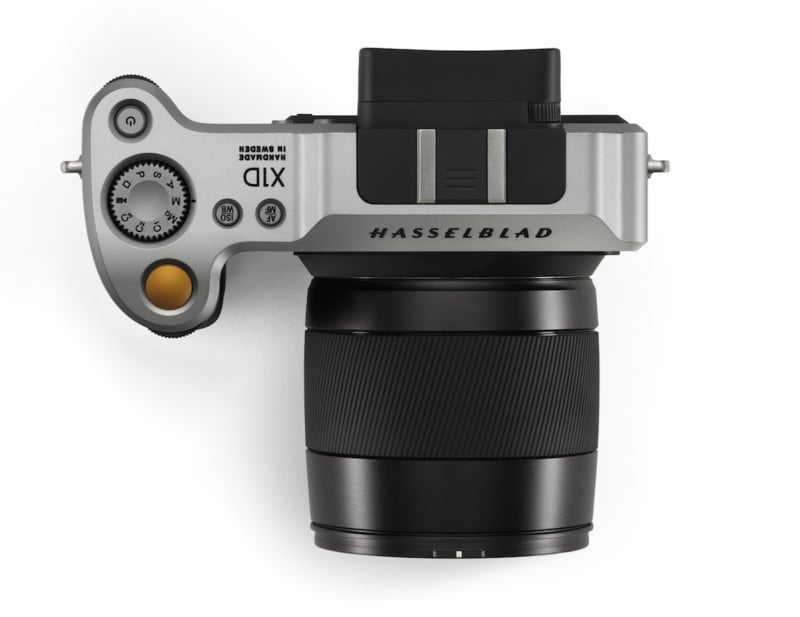
Hasselblad X1D - Mirrorless Digital Medium Format

Camera manufacturer Hasselblad from Sweden just recently launched the Hasselblad X1D.
X1D is the first mirrorless digital medium format camera.

The camera comes with a 50MP CMOS sensor in a housing no larger than a full format DSLR camera.

The sensor has a dimension of 44 x 33m with a single pixel size of 5.3 x 5.3 micro meter.

Together with the camera a new series of lenses has been introduced. This XCD series of lenses are optimised for this mirror less setting. However, current H System lenses fit the camera using an optional adapter.

"Small enough to take anywhere, powerful enough to capture anything."

This invention brings high end glass and sensor technology to a handy form factor which allows the use of digital medium format in many more situations than current solutions.

Saturday, May 28, 2016

"Buy film, not megapixels"

"Buy film, not megapixels" - The 100MP Phase One Alpa Hands-on Review:


Monday, December 21, 2015

Medium Format Cameras

What are reasons to use medium format cameras?

Main reason is the size of the image capturing medium which is either a CCD/CMOS sensor or classic film.
The result is both high resolution with low noise in the image and greater dynamic range with much better transitional tonal values in color.
Both is driven by the larger format compared to 35mm (3-4 times the size) or even crop sensor formats when talking of digital.

Watch the documentary from Karl Taylor explaining the medium format advantages.


Sunday, December 20, 2015

My landscape photography year 2015

On my landscape photography projects I was shooting digital using my Nikon cameras as well as film using my Hasselblad 500 c/m.

Mt. Rigi towards Mt. Pilatus, Nikon D4
Two times I went to mount Rigi in central Switzerland for beautiful landscape
photography.

Especially in winter time - my first trip was in February - this was an interesting experience. The landscape down in the valleys and around the lake Lucerne were covered in fog, while the snow covered peaks of the Swiss Alps were in brightest sunlight.
Mt. Rigi, Hasselblad 500 c/m

The beauty is not only in the breathtaking landscape - which from Mt. Rigi almost covers a 360° view of entire Switzerland - but also in the details. Details such as the snow structures formed by wind and temperature, or the trees covered with frosting made out of snow.

From Rigi Kaltbad, Nikon D4
I went back to Mt. Rigi in autumn. A season of the year where weather conditions usually offer a very clear atmosphere.
I got some very nice shots of the surrounding mountains just after sunset.

Lake Lucerne from Rigi, Nikon D4
On the second day the sky was covered and I got a dramatic picture of Lake Lucerne with Mt. Pilatus in the middle.


Lavender fields, Provence, Nikon D4

As reported earlier (post August 16) we made a short trip to shoot the lavender field landscapes in the Provence, south of France.
This was not only visually but also for the sense of smell a breathtaking experience.
To experience landscapes covered with lavender just shortly before harvest I would not like to miss. The various sensations I will retain for a long time in my memory.
The gallery slideshow below shows some of my photographs from that trip taken on film.

2015 July - Lavender fields - Images by Andreas Mueller

Andalusian landscape, Nikon D800
I made some more trips for landscape photography in 2015 among these a trip to Andalusia.
If you ever want to experience scenic landscapes with olive plantations all around until the horizon then go to Andalusia.
Olivera, Spain, Nikon D800

The pictures here are from a September trip. However, the landscape looks completely different during other seasons. For example in spring everything happens to be green while in autumn the landscape resembles more a desert.


Swiss Alps from the Black Forest by Andreas Müller on 500px.com
Swiss Alps from Black Forest, Nikon D4
Swiss Alps from Jura, Nikon D4
A last series of landscape images I produced this year was around the Swiss Alps from a distance. Some of these images were shot from places in the Jura overlooking the Swiss midland plateau, others were taken from the southern Black Forest in Germany.

"Life is like a landscape. You live in the midst of it but can describe it only from the vantage point of distance." -- Charles Lindbergh


Sunday, November 29, 2015

Photo editing now and then

There is a lot of controversy in the photographers community when it comes to post processing photographs. There are analog photo fanatics who claim that analog is the only real thing while most digital images go through digital post processing including heavy manipulation.

However, photo editing independent of the medium has been part of photographic handcraft ever since.

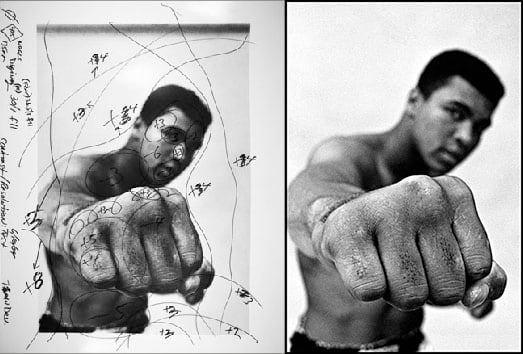
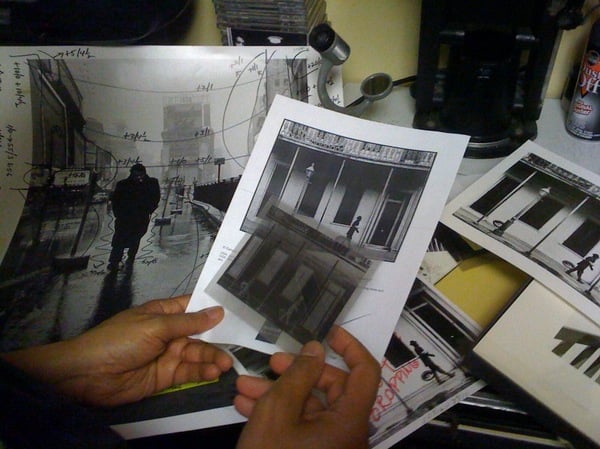
Today I found this interesting article from Michael Zhang (link to PetaPixel) on how iconic prints were edited in the darkroom. The article shows the original first development including markups for later manual editing in a new attempt of development side by side to the final result.
Muhammad Ali, captured by Thomas Hoepker in 1966

The techniques applied in the analog darkroom were not only cropping, cutting out, or adjusting the overall exposure. Having a look at the markups on the sample images of the referenced article a lot is around adjustment of local contrast, detail, background, and local exposure. All elements common to modern digital photo editing (link to Photocritic).

In today's digital world we can apply many steps of editing to one single image. We can easily play with variants, and we can use almost as much time as we want to get the desired result.
Pablo Inirio, darkroom printer at work
In analog technique this all has to happen during the final exposure process of the print in the darkroom by dodging and burning areas of the print and making sure that every area of the photograph gets the right amount of light. This process is a real manual handcraft requiring a lot of experience and a thorough understanding of exposure and development processes. An interesting "before there was Photoshop" 10 minutes video with explanations of these techniques can be found here (link to PetaPixel).

What was the job of a master darkroom printer became the job of an image retoucher in digital times. Techniques remained the same, tools and possibilities might have changed a bit.

Sunday, November 22, 2015

World's first digital camera

First digital camera ever built.
The very first digital camera was developed at Kodak by Steve Sasson forty years ago. The first picture was taken in December 1975.

The image on the left is the camera developed at Eastman Kodak. - Pretty close to how digital cameras look like today ;-)
It used to be called a handheld camera. Quite bulky compared with what we call handheld today.
Interesting is the cassette tape as storage device for the images.

This camera was the result of a project run by Steve Sasson. The scope of this project was to come up with an application for the charge-coupled device, CCD. The result was a prototype camera with no moving parts as a first application of the 100x100 pixel CCD sensor. It took pictures in black and white.

Interestingly Kodak never managed to leverage this leadership in innovation of disruptive technology for the world of photography. Even decades later, Kodak still saw itself as a specialty chemicals and not as an image processing company.

“My prototype was big as a toaster, but the technical people loved it,” Mr. Sasson said. “But it was filmless photography, so management’s reaction was, ‘that’s cute — but don’t tell anyone about it."

Watch the interview with Steve Sasson for some insights into the development of this first application of digital image sensors.