Showing posts with label Kodak. Show all posts

Thursday, April 21, 2016

Iconic film - Kodak Tri-X

Kodak Tri-X: The best black-and-white film ever made? - Read the blog post Zorki Dowling at https://zorkiphoto.co.uk/2016/04/03/kodak-tri-x-film-photography/

Kodak Tri-X came out in 1940 as large format film. In 1954 it was release for 35mm and 120.
The film is on the market for more than 70 years and still widely used today.

Flickr even features a "Kodak Tri-X" group with images shot using this classic film.


Thursday, January 21, 2016

Kodak's CEO Uses 35mm Film as His Business Card

Kodak's CEO Uses 35mm Film as His Business Card: Kodak CEO Jeff Clarke is on a mission to bring film back, and his business card reflects that: it's literally a strip of 35mm film that has his information

Wednesday, January 20, 2016

SUPER 8 - Contemporary 8 mm film movie makers

Have a look at this short documentary on todays SUPER 8 film movie makers.

Also here people are following a hybrid process. The movie is shot on film, film gets developed and finally scanned image by image and edited in a computer.

As this seems to become more and more a common workflow Kodak already offers the most of the process as a service. And many people love it.


"The 8mm Revolution" - SUPER 8 Movie Featurette from Cinelicious on Vimeo.

Tuesday, January 19, 2016

KODAK SUPER 8 :: THE DIGITAL ANALOG HYBRID CAMERA

Kodak is Bringing Back the Super 8 as a Film Camera with Digital Features: While other photo brands are busy announcing their latest and greatest digital cameras, Kodak has a rather unusual unveiling: it's bringing back the legend

A very interesting an not anticipated move. Will this camera business model be successful?

Ted Forbes on this surprising announcement of Kodak:


The new stuff explained by Kodak CEO Jeff Clarke:


Friday, December 25, 2015

Using expired film

Ilford Sportsman, Kodak 200 ASA film
My recent analog photography revival started with a very experimental setting. - The 1959 Ilford Sportsman range finder camera using a more than 10 years expired Kodak 200 ASA film.

For both camera and film I did not know what the results would be. As a result, only a handful of the 24 images were well exposed, sharp and useable. For some of the exposures the leaf shutter of the camera did not work properly.

But overall the visual performance was very satisfying.


2014 June - Kodak 200 ASA - Images by Andreas Mueller

For some more tips on shooting old film read the post from the "I Still Shoot Film" photography blog.
http://istillshootfilm.org/post/118025728220/5-tips-for-shooting-with-expired-film

Sunday, December 13, 2015

The last roll of Kodachrome film

While some of the very popular film from major photography film producers are still available on the market the Kodak Kodachrome 25 slide film has been discontinued in 2001.
Kodachrome, technical data

It was not only the manufacturing of this iconic film but also the discontinuation of the respective K-14 development process using respective chemicals.

The Kodachrome film is three black and white film layered together in one film with each layer being sensitive to one primary color. The film was introduced in 1935 and was used for still photography and cinematography.

Kodachrome, technical data
It was one of the first successful color film materials in widespread use for 65 years.

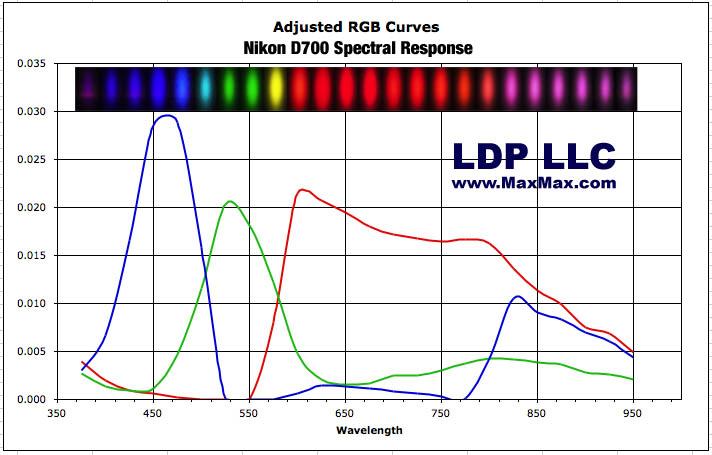
Spectral response, Nikon D700
Compared to the spectral sensitivity of recent digital camera sensors the blues are rather less sensitive than on the exemplary D700 sensor while the reds are on a relative scale more sensitive in the Kodachrome film.

For the digital sensors this is one example and might vary from camera model to camera model.

Similar shifts in spectral sensitivity are the reason for perceived differences in color and vibrance perception comparing film to digital images. This shift of sensitivity towards the red of the color spectrum might be the reason for the "reproduces subtle color naturally" claim in the specification of the Kodachrome 25 film. The human eye exhibits higher sensitivity in the green and red area than in the blue one which is the reason that digital images with their higher contribution in the blue often are perceived as a bit colder in color.

The very last roll of Kodachrome 25 has been shot by photographer Steve McCurry.
An interesting documentary on this project has been produced by National Geographic. Every frame has been shot very carefully in full awareness to produce really special images.


The result can bee seen on Steve McCurry's website in a gallery dedicated to this special project.

Last roll of Kodachrome gallery by Steve McCurry

Sunday, November 22, 2015

World's first digital camera

First digital camera ever built.
The very first digital camera was developed at Kodak by Steve Sasson forty years ago. The first picture was taken in December 1975.

The image on the left is the camera developed at Eastman Kodak. - Pretty close to how digital cameras look like today ;-)
It used to be called a handheld camera. Quite bulky compared with what we call handheld today.
Interesting is the cassette tape as storage device for the images.

This camera was the result of a project run by Steve Sasson. The scope of this project was to come up with an application for the charge-coupled device, CCD. The result was a prototype camera with no moving parts as a first application of the 100x100 pixel CCD sensor. It took pictures in black and white.

Interestingly Kodak never managed to leverage this leadership in innovation of disruptive technology for the world of photography. Even decades later, Kodak still saw itself as a specialty chemicals and not as an image processing company.

“My prototype was big as a toaster, but the technical people loved it,” Mr. Sasson said. “But it was filmless photography, so management’s reaction was, ‘that’s cute — but don’t tell anyone about it."

Watch the interview with Steve Sasson for some insights into the development of this first application of digital image sensors.


Sunday, November 15, 2015

Landscape photography using a Hasselblad 500 c/m - the results


Yesterday the developed and scanned pictures from my landscape photography experiments applying different types of film have arrived.

One first comment: Once more I notice the value of using a tripod even in good light conditions.
All the images were shot hand holding the Hasselblad 500 c/m camera using the waist level finder.

Kodak Ektar 100
Even when keeping an eye on shooting only at shutter speeds faster than 1/60 given the level of detail in the here explored scenics it is hard to reproduce photographs with a high level of detail sharpness.

The fall coloured trees (see the picture of a walnut tree on the left) in the landscape with their tiny details in the texture of colourful leafs are a challenge which only can be overcome using a stable support. In addition weather conditions such as wind might add quick movements to the leafs which results again in motion blur.
Fujichrome Velvia 100

Comparing to my recent  lavender field pictures - see post from August 16th (and sample picture on the right) - where I was shooting every picture using my tripod and fast shutter speeds, the current results are a bit disappointing. Shooting the lavender fields introduced the same, maybe even a bit higher, challenge to capture details in texture of these beautiful plants.
Fujichrome Velvia 50

Applying Fujichrome Velvia film as expected gives rather blueish results a bit less warm in color than the Kodak Ektar 100. The spectrum of the Fujichrome clearly exhibits more contribution at the blue side of the color spectrum, while the Kodak Ektar is more prominent at the yellow/red end of the spectrum.
Kodak Ektar 100

As specified both films exhibit an equally fine granulation. However, the grain can only be observed in bright areas of the sky, as well as in extreme dark green areas of trees in the forest with adequate magnification.

To fully capture the impression of a autumn landscape on a sunny day I would prefer the Kodak Ektar 100 film given the better performance for yellow, brown, and red colors.

Fujichrome Velvia 50
The Fujichrome Velvia was a good choice for the purple lavender fields (compare to picture shown above) as well as for landscape shots where contrast matters, such as in the cloudy evening shot from the Lake Lucerne and Mount Pilatus (see picture on the left).
This picture was extremely difficult to take since there was the very localised, but blurred due to the sky coverage, bright direct light from the sun combined with the very dark south-east facing mountainside in almost true black, and the dramatic sky coverage almost turning the scene into a night shot. It was not very clear to me on choosing the right exposure.
What I wanted to get out of this picture was the dramatic sky combined with the reflection on the surface of the lake, and the band of fog at the bottom of the mountain.

Ilford HP5 400 b/w
Using the Ilford HP5 400 black and white film was a good choice for pictures in the forest where only little light was available in the late afternoon when the sun is low. Given the high contrast between direct sunlight falling on plants and extreme darkness in the shadow this was a real challenge for the Ilford film which is not known to be a high contrast film.
Ilford HP5 400 b/w

As the picture on the right shot through the trees directly into the setting sun shows, the film exhibits good detail a very fine grain but not much graduation between extreme bright and extreme dark.

The image on the left capturing a scene with less extreme lightning conditions shows the film is capable of representing a well balanced scenery in terms of light and color in black and white.

Comparing the two black and white images shows that the Ilford HP5 400 is good under low light conditions. However, the result is much better for a scenery with diffuse light than for one under high contrast conditions.

See more images from this series of analog film photography at my website.
- Rigi Kaltbad
- Autumn landscape

Thursday, November 5, 2015

Landscape photography using a Hasselblad 500 c/m

It needs patients. - There is no immediate feedback control. - The photographer relies sole on a light meter, the selection of a film with specific characteristics, and on his understanding of exposure. - This is analog film photography.

Two weeks ago, it happened to be perfect fall weather in Switzerland, I took my old 1976 Hasselblad 500 c/m camera and some rolls of film, and went for some outdoor activity.

During fall and winter the low sun leads to interesting ambient light conditions. Lot of contrast, and due to the clear atmosphere also clear and brilliant colours with plenty of contrast.
The vibrant colours of autumn leaves - yellow, red, brown, and green - were just amazing.

I decided to shoot the following different film rolls.

Kodak Professional Ektar 100
The technical data sheet claims: "... is the world's finest grain color negative film ... high saturation and ultra-vivid color..." and "... is recommended for applications such as nature, travel and outdoor photography, as well as for fashion and product photography."

Fujichrome Velvia 50 Professional, and 100 Professional
The Fujifilm product bulletin says: "... is a professional daylight color reversal film..." and "... the world's highest level of image color saturation and vibrancy, this film combines superb granularity with resolving power.", "It is especially suited to subjects that demand precision in reproduction and emphasis in colors."

Hence, for the color films I was dealing with the world's finest grain, the world's highest level of color saturation, and resolving power. Both types of film are recommended - among other applications - for outdoor photography.

Spectral density curves Fujichrome Velvia 50

Comparing the spectral sensitivity curves from the film's technical specifications for both types of film shows that both films exhibit similar spectral response in blue and green wavelength area. The red area covers approximately the same wavelength range for both films with the spectral density being narrower for Fujichrome Velvia compared to Kodak Ektar.

Kodak Ektar shows a broad peak between 600 and 660 nm while the Fujichrome Velvia spectrum has a narrow peak at 650 nm.
This explains the experienced difference in color of the two film. The Fujichrome Velvia gives rather blueish results, given the lack of red and the predominance of blue and green (see spectral density charts on the left).

Spectral density curves Kodak Ektar 100
While Fujichrome Velvia is known for its saturation and strong contrast, I  am curious to see the results of Kodak Ektar.


Ilford HP5 Plus - ISO 400 black and white professional film
The package insert speaks of a "...high speed, medium contrast film...", "...suitable for action and press photography..."  - Not necessarily the first choice for black and white landscape photography. If reading through other blog posts. This film is never recommended explicitly. Recommendations go rather for Kodak Tri-X, BW400CN, or Ilford XP2 Super film.
Nevertheless, Ilford HP5 is considered to be a good option since it is a very flexible film yielding "...outstanding sharpness and fine grain under all lighting conditions". It's a medium contrast film and hence probably a good choice to reflect the nuances of colorful autumn leaves and forests in black and white.

Shooting film, time to result can be a bit longer than with modern digital technique. I am still waiting for developed and scanned films to arrive.