Showing posts with label analogue. Show all posts

Friday, December 25, 2015

Using expired film

Ilford Sportsman, Kodak 200 ASA film
My recent analog photography revival started with a very experimental setting. - The 1959 Ilford Sportsman range finder camera using a more than 10 years expired Kodak 200 ASA film.

For both camera and film I did not know what the results would be. As a result, only a handful of the 24 images were well exposed, sharp and useable. For some of the exposures the leaf shutter of the camera did not work properly.

But overall the visual performance was very satisfying.


2014 June - Kodak 200 ASA - Images by Andreas Mueller

For some more tips on shooting old film read the post from the "I Still Shoot Film" photography blog.
http://istillshootfilm.org/post/118025728220/5-tips-for-shooting-with-expired-film

Thursday, December 24, 2015

Hasselblad 500 history

Learn something about the history of Hasselblad camera models. S. Heymann and Q.G. de Backer compiled a concise tabulated history including a serial number look up for manufacturing years. - Follow the link.

My Hasselblad 500 c/m (Made in Sweden by Victor Hasselblad) was built in 1976. The 80 mm f2.8 Carl Zeiss T* Planar lens I am using is from 1981.

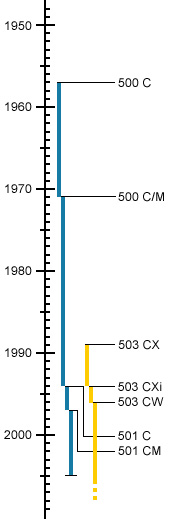
The 500 c/m model has been manufactured from 1970 until 1994. And was a follow-up of the 500 c model adding the possibility of interchanging the focusing screen by the user.

Hasselblad company was founded in Gothenburg, Sweden in 1941. Right after world war II.

Moon buggy, Apollo space program
The most famous use of Hasselblad equipment was during the NASA Apollo space program. Some of the most spectacular images from manned exploration of space have been taken using Hasselblad cameras.

The Hasselblad 500 c/m model is still a quite popular camera in film photography. No longer being manufactured since more than 21 years, the market for 500 c/m cameras is still there. On eBay a good maintained Hasselblad 500 c/m set including a 80mm lens goes around 1'000 Euro. Similar as for old used cars there can  also be found a market for spare parts and repair services for old mechanical cameras.

#Bike by Joe Hirtenfelder on 500px.com
#Bike by Joe Hirtenfelder
(500px: Hasselblad film photography)
■
by Shinya
(Flickr: Hasselblad film photography)
Hasselblad cameras are still widely used. A search for "Hasselblad" in the film photography section at 500px yielded a number of more than 2'000 analog images.

Among these Hasselblad analog photographs there are a lot of still life, landscape, and people images.

My own Hasselblad 500 c/m analog photography can be found at: andreasrmueller.com


Tuesday, December 8, 2015

Photography reading list

For anybody who wants to start film photography. - Here a reading list from the #istillshootfilm blog with very valuable recommendations.

http://istillshootfilm.org/post/534856924/the-essential-reading-list-for-film-photography

Sunday, December 6, 2015

Printing in the darkroom

25 years ago I used to do my own black and white prints in the darkroom. It was a good time having full control over the entire photographic process. - Playing around with old cameras and film recently made me think of restarting the darkroom handcraft. - I am still not sure if I should setup a darkroom lab, get some used equipment and start developing my own artistic process end to end.

Here an article I came across on photographic enlargers, the hart of darkroom equipment:

http://istillshootfilm.org/post/130262852345/photographic-enlargers-101

Saturday, December 5, 2015

12 Reasons Photographers Still Choose to Shoot Film over Digital

12 Reasons Photographers Still Choose to Shoot Film over Digital

Experimental film


This is another post on analog photography using non standard film. Some creative experiment playing with the imaging media.

Randomly I ordered some special film through the internet. Now I am trying to figure out what to shoot with it. As described in an earlier post when using different color film to capture the colors of our fall landscapes understanding something about the technical, or chemical background of the film is needed in order to make the right choice.

Rollei INFRARED 120: an ISO 400 black and white film:
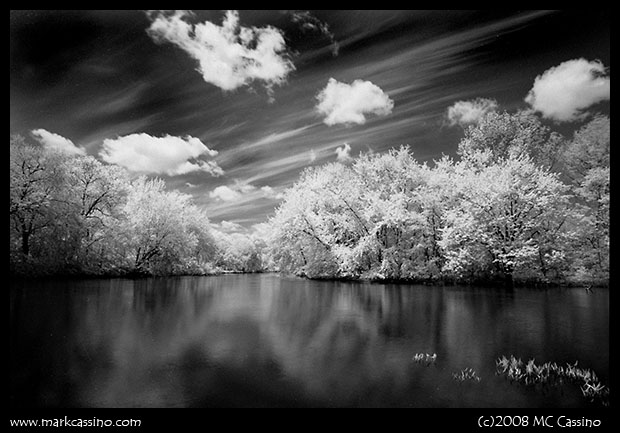
This is a special infrared film with spectral sensitivity up to 820 nm. This is more than 100 nm further towards the longer wavelength compared to the spectral sensitivity of the human eye which goes to 700 nm.
Images of a landscape setting with deep blue sky should result in a very dark, almost black sky since infrared is absorbed by the water in the atmosphere and not reflected back into the camera. Same applies for water. Foliage of trees becomes very bright since the leaves of plants reflect a lot of the infrared light.
Rollei Infrared ISO 400

There is no big IR effect when not applying an IR filter - meaning, a filter blocking all colors in the visible range of the spectrum an letting pass the infrared contribution only. If no filter is being used, the absorption in the visible range of the light spectrum is predominant.


Rollei Crossbird Creative Edition: an ISO 200 color film:
Crossbird can be processed as standard E-6 slide film or it can be cross processed in C-41 process producing interesting altered, retro color shifts.
Rollei Crossbird ISO 200

This film in general exhibits coarse grain and a rather greenish color spectrum.


Lomography Color Negative: an ISO 100 color filme:
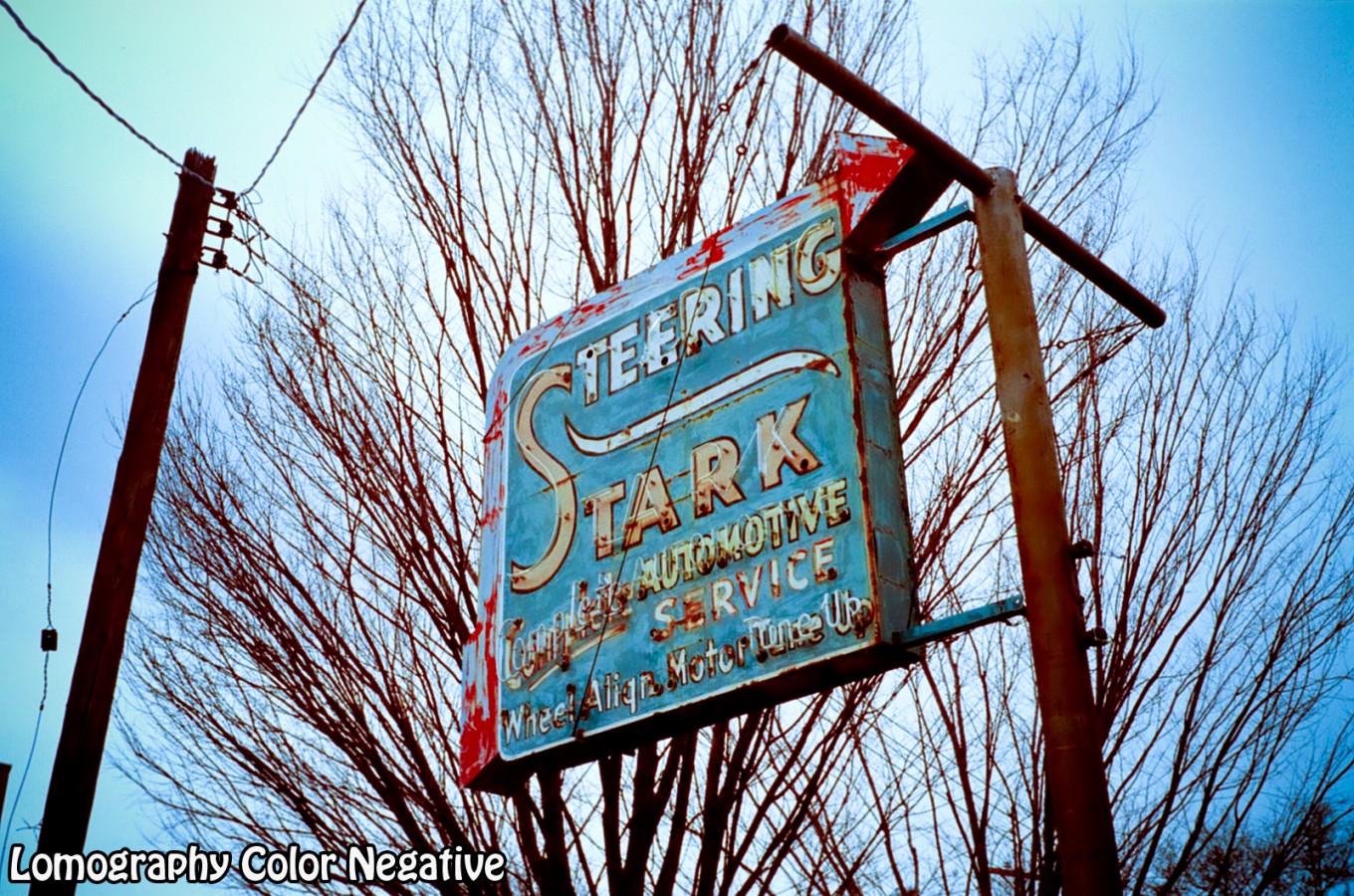
This is a color negative film for bright sunlight conditions giving results with vivid colors.
Lomography Color Negative ISO 100

Example images show a rather cold color temperature, meaning a strong blue contribution.

The Lomography films are also referred to as "toy films". However, Lomography films are just rebranded films in earlier times produced and supplied by Kodak, Fuji, Agfa, ...


Lomography Black and White Earl Grey: an ISO 100 black and white film:
The Lomography Earl Gray Black&White film seems to be a rebranding of the Foma Fomapan 100 Classic. This film shows low granularity, high resolving power and contour sharpness, and displays a wide range of halftones.
Lomography Black&White Earl Grey ISO 100

This seems like a very performant black and white film when detail, contrast and sharpness is required.


For reference please refer to the websites of respective film suppliers:
- Rollei film
- Lomography