This is another post on analog photography using non standard film. Some creative experiment playing with the imaging media.
Randomly I ordered some special film through the internet. Now I am trying to figure out what to shoot with it. As described in an earlier post when using different color film to capture the colors of our fall landscapes understanding something about the technical, or chemical background of the film is needed in order to make the right choice.
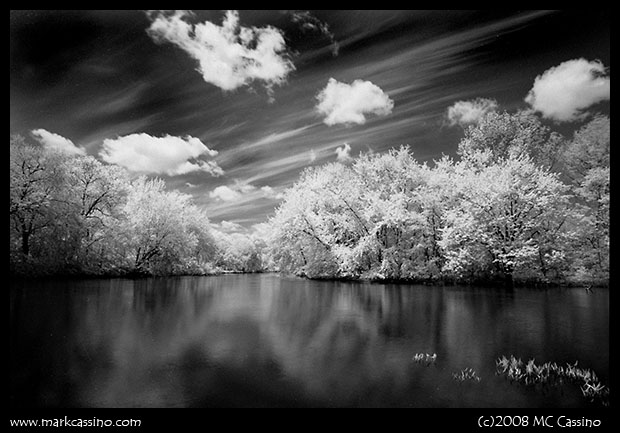
Rollei INFRARED 120: an ISO 400 black and white film:
This is a special infrared film with spectral sensitivity up to 820 nm. This is more than 100 nm further towards the longer wavelength compared to the spectral sensitivity of the human eye which goes to 700 nm.
Images of a landscape setting with deep blue sky should result in a very dark, almost black sky since infrared is absorbed by the water in the atmosphere and not reflected back into the camera. Same applies for water. Foliage of trees becomes very bright since the leaves of plants reflect a lot of the infrared light.
 |
| Rollei Infrared ISO 400 |
There is no big IR effect when not applying an IR filter - meaning, a filter blocking all colors in the visible range of the spectrum an letting pass the infrared contribution only. If no filter is being used, the absorption in the visible range of the light spectrum is predominant.
Rollei Crossbird Creative Edition: an ISO 200 color film:
Crossbird can be processed as standard E-6 slide film or it can be cross processed in C-41 process producing interesting altered, retro color shifts.
 |
| Rollei Crossbird ISO 200 |
This film in general exhibits coarse grain and a rather greenish color spectrum.
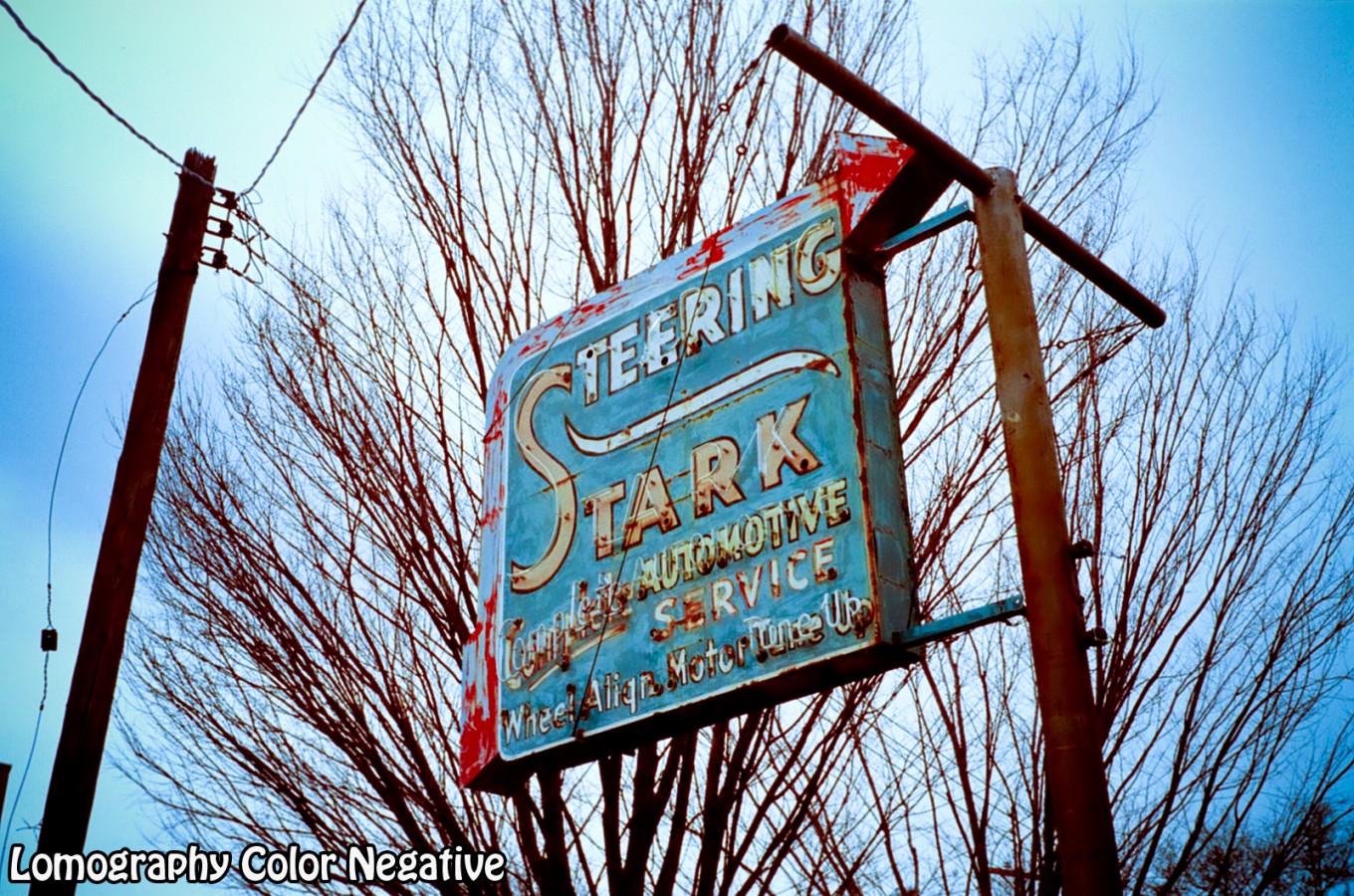
Lomography Color Negative: an ISO 100 color filme:
This is a color negative film for bright sunlight conditions giving results with vivid colors.
 |
| Lomography Color Negative ISO 100 |
Example images show a rather cold color temperature, meaning a strong blue contribution.
The Lomography films are also referred to as "toy films". However, Lomography films are just rebranded films in earlier times produced and supplied by Kodak, Fuji, Agfa, ...
Lomography Black and White Earl Grey: an ISO 100 black and white film:
The Lomography Earl Gray Black&White film seems to be a rebranding of the Foma Fomapan 100 Classic. This film shows low granularity, high resolving power and contour sharpness, and displays a wide range of halftones.
 |
| Lomography Black&White Earl Grey ISO 100 |
This seems like a very performant black and white film when detail, contrast and sharpness is required.
For reference please refer to the websites of respective film suppliers:
-
Rollei film
-
Lomography