
Showing posts with label wildlife. Show all posts
Showing posts with label wildlife. Show all posts
Tuesday, December 20, 2016

Thursday, December 8, 2016
New Underwater Photography Section at andreasrmueller.com
I restructured and simplified my underwater photography archive page on andreasrmueller.com in order to better reflect the biodiversity of different marine areas on earth.
Follow the following link for an impression: link
My first pictures diving the pacific ocean will be available in a years time when diving Cocos Island off the coast of Costa Rica.

Tuesday, December 6, 2016
Thursday, November 24, 2016
Wildlife Photography: Japanese Snow Monkeys

Famous for taking a bath in the hot springs while outside it is snowing. This should be a target for every ambitious nature and wildlife photographer.
Here a National Geographic documentary: link
Wednesday, October 26, 2016
Influential Photographers - Thomas Marent

His photographic career started at age 16 when he took his first SLR camera out to the local Flachsee in central Switzerland to shoot his first nature images in local wetlands.
In 2006 he released his first book with an international editor which allowed him for the first time to make a living out of photography.

The job of the nature photographer is heavily driven by the ability of being patient. To get the one perfect shot in nature and wildlife it can take days and weeks of patients, adaptation to the environment, and building the right setup.
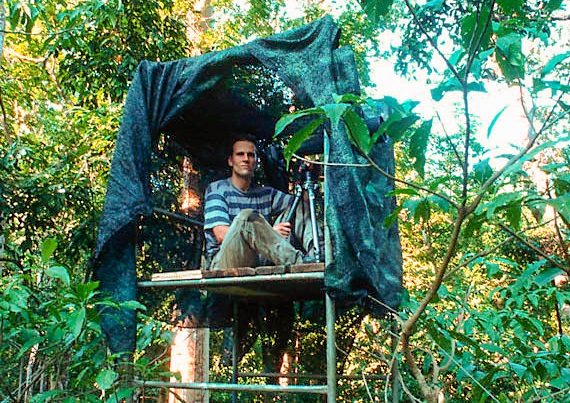
To get these impressive close shots, such as the gorilla drinking in the river (see below) one needs a whole lot of experience. Experience, not only as a photographer but mainly as somebody who understands nature and wildlife and who can read the behaviour and reaction of wild animals.

Tuesday, October 18, 2016
Tuesday, October 11, 2016
Friday, October 7, 2016
Photography Tutorial: How To Get Better Shark Photos Underwater | Scuba Diving

While diving the last couple of years the reefs of the coral triangle in South East Asia I was mainly facing macro wildlife and beautiful coral seascape.
Here another photo tutorial worth reading:
Photography Tutorial: How To Get Better Shark Photos Underwater | Scuba Diving
Tuesday, October 4, 2016
Tuesday, September 27, 2016
Tuesday, June 14, 2016
Monday, June 13, 2016


Tuesday, June 7, 2016
Squadron of Hope - Raja Ampat
A short video by Nu Parnupong documenting the richness of reef life around Misool, Raja Ampat, Indonesia.
Sunday, June 5, 2016
Underwater Macro Photography in Cabilao, Philippines

I was diving with Sea Explorers who has a very good infrastructure to serve the needs of underwater photographers.
Cabilao is located at the west side of Bohol island facing Cebu island. The reefs around Cabilao are rich in coral growth and macro life. But, accidentally you can also spot bigger marine wildlife such as mobula rays, eagle rays, turtles, or sharks.

And there are several places to see for example several species of pigmy sea horses (hippocampus bargibanti in different colors, hippocampus denise).
Currents are quite predictable in the area so that dive guides can very well adapt to skill of divers, or whites and interest of their guests.
 There can be found some very rare to spot species too.
The pigmy sea dragon, or pigmy pipe horse on the right is only one of them.
This is a species incredibly difficult to photograph.
It is very small. The sea dragon shown here was not longer than 5 mm and constantly moving.
This one was living in a coral hidden in a little cave where it was hard to position camera and strobes.
The hardest part is actually finding the subject in the view finder of the camera, or if you are using a compact camera on the display.

This one was feeding on star fish and living quite local.
Also here, the photographic challenge was to get the right point of view and correct positioning of the light without destroying the reef.
Taking macro pictures under water needs patience, good diving (buoyancy) skills, a buddy assisting, and most important diving in a very small group. There is nothing more annoying than photographers queuing behind subjects and stressing each other to get equal exposure to opportunities.
More images can be found at my website at www.andreasrmueller.com
Tuesday, May 31, 2016
Friday, April 29, 2016
Wildlife Photography Using Hidden Camera-Traps
This is a short documentary by wildlife photographer Will Burrard-Lucas on using hidden camera-traps to capture African wildlife in Namibia.
Sunday, April 17, 2016
Saturday Morning at the Zoo
 Saturday morning at the Zoo. - When wildlife
 awakens.
Some weeks ago I went to the Basel Zoo together with some of my photography friends. An opportunity to use once more the big glass sitting most of the time in the storage at home.

My setup for the day was the following:
Glass: Nikkor 300mm f2.8 VR II together with teleconverter TC-20E III
Support: Manfrotto
For results visit my 500px profile.

Main difficulties taking photographs at the zoo using long focal length setups are caused by finding the right perspective across the fence and finding the right background.
Most of the time, even tough not in focal plane, the very geometrical structure of the fence causes blurred areas in pictures to end up with certain unwanted structure.
Same applies to background. In a zoo the farfield background often is something one would not expect the main subject - exotic animals - to sit in.
More images of my friend Joe Lackner using Nikon D800 with the Nikkor 200 - 500 mm lens can be found at http://joephoto.jimdo.com/tiere/zoo-basel/
Most of the time, even tough not in focal plane, the very geometrical structure of the fence causes blurred areas in pictures to end up with certain unwanted structure.
Same applies to background. In a zoo the farfield background often is something one would not expect the main subject - exotic animals - to sit in.
More images of my friend Joe Lackner using Nikon D800 with the Nikkor 200 - 500 mm lens can be found at http://joephoto.jimdo.com/tiere/zoo-basel/
Wednesday, April 6, 2016
Kim Yusuf - Underwater Photography
Since quality of compact cameras became more serious and availability of underwater camera housings is given underwater photography almost became a commodity. Looking through picture archives such as Facebook, flickr, 500px, and more the number of published underwater imagery is endless. And many of the images are average.
A couple of years ago I met Kim Yusuf, German underwater photographer on a North Sulawesi trip to Bangka Island and Bunaken marine park.
We were diving together at some exceptional dive spots. And already under water I could see that Kim was up to get the "big picture".
 Kim and his wife, always worked closely together to get the big shot. Kim's wife referred to herself as "head of snoot operations". And you can see the quality of that collaboration in the results.
After that trip I googled for him and found his work on flickr and on his personal web site.
Some of his images truly are cutting edge in underwater photography. Both macro and wide angle images are well composed and exposed. Something many underwater photographs are missing.
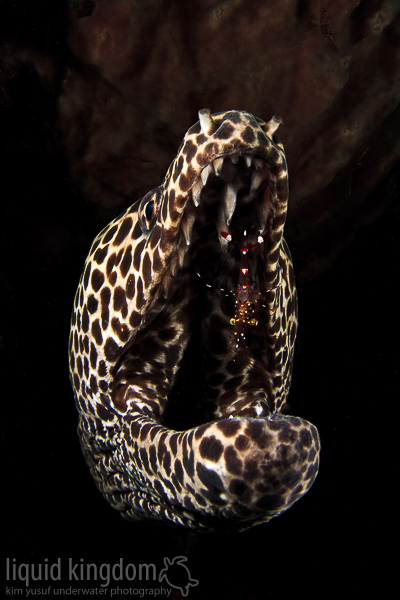 I can only recommend to explore Kim's gallery and web site for inspiration.
Kim travelled many places on earth to capture special nature phenomena.
Browsing through Kim's portfolio I am deeply impressed. Especially by his close up images of interactions between marine animals. Myself, diving and taking underwater pictures since many years I even did not really see respective situations underwater. Some of these images are truly unique.
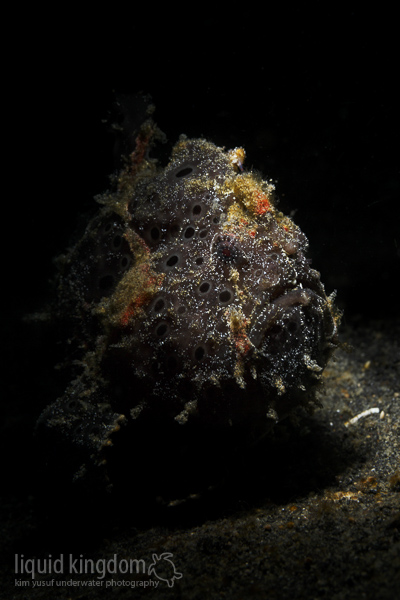 For the gear aficionados, Kim let's you to explore his portfolio by camera, lens, iso, exact location, ...
Tuesday, April 5, 2016
Pilot whales in Raja Ampat
Raja Ampat, the center of the coral triangle, the area with highest marine biodiversity on earth, is an exceptional place for underwater photographers and underwater videographers. But sometimes, given by the unpredictability of nature some of the biggest marine wildlife spectacles can best be captured from the air.
Watch that exceptional movie of a large school of pilot whales taken - probably by the owner of the Pindito livaboard, Edi Frommenwile!
Watch that exceptional movie of a large school of pilot whales taken - probably by the owner of the Pindito livaboard, Edi Frommenwile!
Monday, December 21, 2015
The Majesty of Manta Rays

The oceanic manta reaches 7 m in width while the reef manta reaches 5.5 m. They are dark brown or black on top while mostly white underneath. With this colouring they are well camouflaged in the water both when spotted from the bottom against the bright sky or when viewed on from the top against the dark background of the deep sea.
.jpg) Manta rays are an endangered species listed in the "vulnerable" category of the red list of the international union for conservation of nature. Primary threat is fishing bycatch. Among other threats is deterioration of their habitat and unregulated tourism. Pollution of the oceans, floating waste, and disturbance by mass tourism are main reasons for manta populations to disappear.
Manta rays are an endangered species listed in the "vulnerable" category of the red list of the international union for conservation of nature. Primary threat is fishing bycatch. Among other threats is deterioration of their habitat and unregulated tourism. Pollution of the oceans, floating waste, and disturbance by mass tourism are main reasons for manta populations to disappear.The infographic on the right shows the fisheries value of a dead manta compared to the value of a manta alive over its entire lifetime. Hence, the economic value of controlled and mild tourism is by orders of magnitude higher than the direct fishing income.
There are several conservation organisations taking care of manta rays specifically.
Manta watch: this is a project which found a low-cost solution to collect data around manta occurrence by collecting photographs from scuba divers world wide including location of where pictures have been shot. Identifying unique patterns on the mantas' skin allows to keep track of manta movements. - For all the scuba divers, please contribute your images of manta rays to this innovative project and help to enrich their database.
Manta trust: this is an organisation doing research around manta rays raising awareness and providing education to the genreal public and community stakeholders.
Manta pacific research foundation: is a research foundation to study manta rays in their natural habitat.
 |
| Manta ray at dive spot Magic Mountain, Misool Raja Ampat |
Manta rays are rather shy animals. Hence, it is difficult to get into a situation where they come and stay close enough for a spectacular underwater photography.
 |
| Collection of manta ray images at 500px |
A selection of my own manta pictures can be found at: link
A search at 500px yields more than 300 underwater images of manta rays. Some of them are really spectacular!
Subscribe to:
Posts (Atom)